

Tennis is a sport of explosive power, repetition and asymmetrical movement patterns. Serving places enormous stress on the shoulder and spine, groundstrokes demand rapid trunk rotation and matches can involve a significant amount of high intensity changes of direction, accelerations and decelerations.
These unique physical demands mean injuries are common, even in well trained competitive players.
For tennis players of all levels in Adelaide, looking after your body is just as important as refining your serve, you forehand, backhand, or even improving your match fitness. This article explores common tennis injuries, recent research insights and how physiotherapy can help keep you on the court longer playing your best.
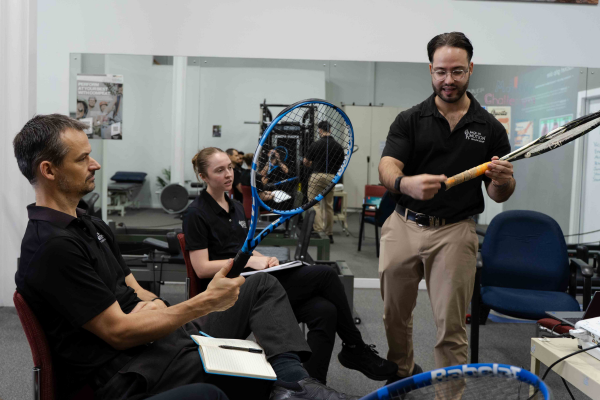
The Physical Demands of Tennis
Tennis places significant physical stress on the body. Long matches, year-round competition, harder court surfaces and increased training volumes all contribute to higher injury risk.
Injury Incidence:
Epidemiological studies report injury rates in tennis ranging from 2 to 20 injuries per 1,000 hours of play, with overuse injuries accounting for the majority (Fu et al., 2018).
The Risk of “Workload Spikes”:
Research consistently shows that sudden spikes in training or match load—such as increasing sessions—significantly increases the risk of upper limb injuries (Moreno-Pérez et al., 2021).
The 60% Rule:
A study on high-performance junior tennis players found that a high “acute workload” (total training in a single week) significantly increases injury risk. In fact, the risk increases by over 60% for every substantial jump in weekly training volume (Johansson et al., 2022).
In short, tennis performance requires smart load management, not just more court time.
Common Tennis Injuries
Shoulder Pain
One of the most common problems in tennis is shoulder pain. Repeated overhead serving places high rotational and compressive forces through the shoulder.
This can lead to rotator cuff overuse, labral injuries, or biceps tendinopathy from fast acceleration and deceleration forces.
Poor scapular control and limited thoracic mobility are frequent contributors.
Tennis Elbow
Despite the name, this condition is caused by repetitive gripping and wrist extension, not just poor technique.
Racquet string tension, grip size, training volume and forearm strength all influence risk. Tendon overload can occur gradually and often worsens if ignored.
Lower Back Pain & Stress Injuries
Serving and groundstrokes require repeated trunk rotation, extension, and side bending often biased to one side. Over time this can cause lumbar joint irritation, disc overload or even bone stress reactions, particularly in competitive juniors and high volume players.
Hip & Groin Pain
Lateral movement, open stance hitting and rapid directional changes place high loads through the hips and groin. Weakness and reduced hip mobility can lead to adductor overuse pain, hip flexor strains, or femoroacetabular joint irritation.
Knee & Ankle Injuries
Hard courts and quick changes of direction increase stress on the knees and ankles.
Common issues include patellar tendinopathy, ankle sprains, and Achilles tendinopathy, often linked to fatigue, footwear, or inadequate lower limb strength.
A recent sports medicine review highlighted that overuse injuries dominate tennis, particularly in the shoulder, elbow, and lower limb, reinforcing the importance of early intervention and load management (ITF Sports Science Review, 2023).
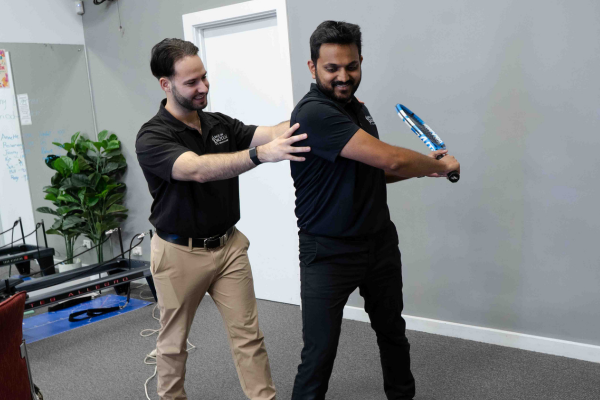
Why Pre-Season Screening Matters in Sport
Injury prevention is far more effective than injury rehabilitation.
A tennis-specific physiotherapy screen can:
- Test strength: rotator cuff, scapular stabilisers, core, hips, calves.
- Assess mobility: shoulder rotation, thoracic spine, hips, ankles.
- Analyse biomechanics: serve mechanics, groundstroke patterns, footwork.
- Review workload: training volume, match frequency, rest and recovery.
Evidence shows athletes exposed to poorly managed workloads are significantly more likely to develop overuse injuries, particularly when returning from breaks or injuries (Hulin et al., 2014).
Physiotherapy for Tennis Injury Recovery in Campbelltown
When injury occurs, effective rehab goes beyond pain relief. The goal is to restore movement quality, improve tissue capacity, and reduce the risk of recurrence.
Our Clinical Approach
At Back in Motion Campbelltown, our physiotherapist Petros Clironomos enjoys working with tennis players of all levels.
Tennis injury management includes:
- Accurate diagnosis: Thorough clinical assessment and referral for imaging or medical review when required.
- Targeted treatment: Manual therapy and a progressive strengthening tailored to tennis demands.
- Biomechanical correction: Addressing serving mechanics, stroke efficiency and movement patterns where needed.
- Load monitoring: Structured return to training to avoid sudden spikes.
- Graded return to play: Tennis specific drills to rebuild confidence and performance.
Take Home Message
Whether you’re a weekend social player, competitive junior, or seasoned tournament athlete, your body is your most valuable piece of equipment. Investing in injury prevention and early physiotherapy care is the key to staying pain free, consistent, and competitive on the tennis court.
Ready to stay match fit?
Give us a call on 08 8365 7966 or click here to book a tennis injury screen or rehab session with Petros Clironomos at Back in Motion Campbelltown today.
————————————————————-
References
1. Fu, C et al. Epidemiology of injuries in tennis players, Current reviews of musculoskeletal medicine. 2018
2. Moreno-Pérez et al. Association of acute and chronic workloads with injury risk in high-performing junior tennis players, European Journal of Sport Science, 2021
3. Johansson F et al. Association Between Spikes in External Training Load and Shoulder Injuries in Competitive Adolescent Tennis Players: The SMASH Cohort Study, Sports Health, 2022
4. ITF Sports Science Review. Tennis injury epidemiology and prevention. 2023.
5. Hulin BT, et al. Acute: chronic workload ratio predicts injury. Br J Sports Med. 2014.
Author Petros Clironomos, Physiotherapist Back in Motion Campbelltown