

Cricket is often labelled a sport of minimal injury risk. However, with the changing dynamics of the game and the repetitive nature of the sport, cricketers can be susceptible to a wide range of injuries.
Research has suggested that bowling is by far the most common cause of injuries in cricket (41%). The vast majority of these injuries are overuse injuries, where the repetitive action in players with poor biomechanics (movement patterns) eventually cause back injury.
In the act of fast bowling – particularly the arching and rotation of the lower back - a lot of stress can be placed through the joints and bones in the spine.
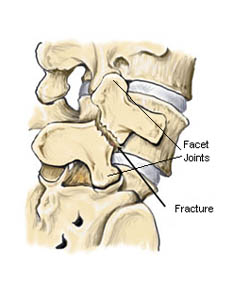
Initially, the stress is placed on the facet joints that are located on each side of the spinal vertebrae (bones) to connect each vertebra together.
If left unmanaged however, the stress can be transferred to the connecting bone of the vertebra, causing a stress reaction. In severe cases a stress fracture may develop (image, right).
Bowling injury symptoms
Facet joint injury
- Pain on one side of the low back (usually same side as bowling arm)
- Worse when bowling
- Pain with arching or rotating back
Stress reaction/stress fracture
- Pain on one side of the low back, often radiating into the buttock region
- Worse when bowling – may limit ability to complete spell
- Pain with arching or rotating back
- Pain often worse at night
Why do bowling injuries occur in cricket?
Factors that can contribute to these injuries include inadequate pre-season physical preparation, rapid increase in training load (perhaps after a recent rest period), postural problems, imperfect bowling technique, length of bowling spells in matches, and lack of core strength.
How are cricket injuries treated?
Once an injury has occurred work needs to be done to correct the underlying contributing factors.
Continuing to bowl with low back pain will significantly impact on your enjoyment and performance.
So if you are a fast bowler and experiencing any low back discomfort, it would certainly be worth seeing your local Back In Motion physiotherapist. There may in fact be some simple treatment that can alleviate your symptoms and prevent a more serious stress fracture occurring.
Author:
Dan Verdon (Member APA) - Physiotherapist and Clinical Mentor at Back In Motion Camberwell
Related Articles