

Over the past 12 months, “working from home” has become a phrase that we have all become a little too accustomed to hearing. Although possessing its many pros, such as eradicating the hour-long train commute and working in your pyjamas, it is unfortunately not without its challenges. One of which, is the newly acquired back and neck pain that you may have found yourself with after spending hours sitting at a laptop at the dining room table.
However, there are some simple modifications you can make that will make the hours of Zoom meetings significantly more tolerable.
1. Ensuring your work set-up is ergonomic
You’ve heard it from the OH and S team and now you are going to hear it from me: work set-up is so important! In 2019, the Health and Safety Executive completed a health and safety at work report for Great Britain1. The report found that 40% of all musculoskeletal disorders were related to the back, showing a clear link between work-related ergonomics and back pain. It was suggested that the high incidence rate was due to tiring body positions, prolonged desk sitting, repetitive actions and poor manual handling.
Here are some key points to consider when setting yourself up at home [see image]:
- Screen height: Ensure your screen is not too low or too high – the top of your screen should be set at eyelevel, to ensure you do not have to consistently look up or down2. Screen height can be raised using things already found in your home, such as placing your screen on a pile of books.
- Ergonomic chair: Ideally, your chair should have a backrest which supports the curve of your lower back. For additional support, you may consider purchasing a lumbar roll or rolling up a towel and placing it behind you. Your chair should allow your hips and knees to be at 90 degrees, with your feet resting comfortably on the ground.
- Posture and keyboard techniques: elbows should be bent at approximately 90 degrees, resting on either your table or armrests.
- Consider a Sit-Stand work station: changing positions frequently throughout the day plays a key role in reducing back and neck pain. A sit-stand desk will allow you to avoid prolonged standing or sitting postures, hence varying the load placed on your spine.
2. Taking regular breaks
When you are in the office, you may notice you stand up from your desk a lot more regularly than you do when working from home. This is one of the big factors that can influence back and neck pain. A recent study found that those who sat for longer throughout the day had a higher prevalence of lower back pain.3 An additional study showed that sustaining an “awkward sitting posture” for half a workday significantly increased the likelihood of lower back pain.4 It is recommended that you take a short break from your desk every 20-30 minutes to avoid prolonged positioning and hence reduce the risk of back/neck pain.
3. Implementing stretching/exercise at your desk or after your workday
As mentioned, any sustained position can place load on your joints and spine, leading to a build-up of stiffness over time. A systematic review completed in 2008 found that there was some beneficial effect of stretching to prevent work-related musculoskeletal disorders5. Here are some simple stretches/exercises you can carry out either at your desk or during your breaks:
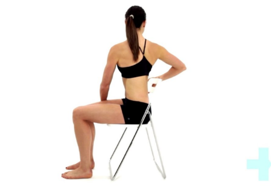
Thoracic rotation
- While sitting on a stable chair, rotate as far as possible to 1 direction, as if to look behind you, using the back of the chair to provide overpressure.
- Hold for 3 seconds and return to the centre.
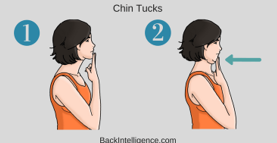
Chin tucks
- Sit in a neutral position and slowing glide your head backward, tucking your chin in.
- Hold for 3 to 5 seconds and then release.
- Repeat 10 times.
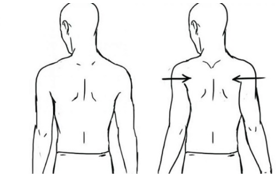
Shoulder retractions
- Start with your shoulders in a neutral position.
- Bring your shoulders back as if you are trying to squeeze your shoulder blades together.
- Hold for 3 seconds and then return to your starting position.
A combination of all of these simple modifications can help to reduce your likelihood of workplace-related back and neck pain while working from home. However, if symptoms continue to develop or persist and you would like help overcoming them – book in with us online or by calling the practice on 9836 1126.
References
- Health and Safety Executive. (2019) Work Related Musculoskeletal Disorder Statistics. In Great Britain, 2019. [PDF] London: 7-8.[last accessed 15/02/2021]
- Al-Otaibi ST. Prevention of occupational back pain. Journal of family & community medicine. 2015 May;22(2):73.
- Gupta, N., Christiansen, C., Hallman, D., Korshøj, M., Carneiro, I. and Holtermann, A. (2015) Is Objectively Measured Sitting Time Associated with Low Back Pain? A Cross-Sectional Investigation in the NOMAD study. PLOS ONE 10(3): e0121159.
- Lis, A., Black, K., Korn, H. and Nordin, M. (2006) Association between sitting and occupational LBP. European Spine Journal 16(2): 283-298.
- Da Costa, B. R., & Vieira, E. R. (2008). Stretching to reduce work-related musculoskeletal disorders: a systematic review. Journal of Rehabilitation Medicine, 40(5), 321-8. doi: 10.2340/16501977-0204