

Shoulder pain can make everyday life surprisingly difficult. Reaching overhead, putting on a shirt, lifting something, or even sleeping on your side can become uncomfortable. One of the most common causes of shoulder pain is rotator cuff-related shoulder pain (RCRSP). But what exactly does that mean, and what can you do about it?
What is the rotator cuff?
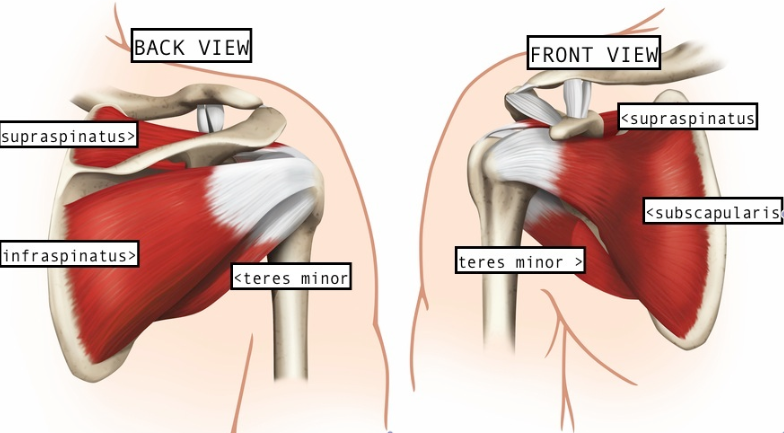
The rotator cuff is a group of four muscles that attach to form one tendon that help keep your shoulder stable and allow you to move your arm. When these tissues become sensitive or overloaded, you may develop pain around the front or outside of your shoulder.
Common Symptoms:
- Lifting your arm overhead
- Reaching behind your back
- Putting on clothes
- Lifting or carrying
- Sleeping on the painful side
- Doing repetitive upper limb activities
- Potentially may also notice weakness or reduced confidence in using your arm
Does shoulder pain mean you've damaged your rotator cuff?
Not necessarily!
- Shoulder pain doesn't always mean something is torn or seriously damaged. Often, symptoms develop when the demands placed on your shoulder increase faster than your shoulder is able to tolerate.
- This might happen after starting a new gym program, doing more gardening, painting, playing sport, or simply increasing your usual activity.
Should you rest it?
Resting completely usually isn't the answer.
- Think to modify activities initially, then gradually rebuild.
- Temporarily reduce activities that significantly aggravate your pain, but keep your shoulder moving. As your symptoms settle, gradually increase your strength and activity levels.
What can help?
- For most people, progressive exercise is an important part of recovery. Other modalities such as manual therapy, laser, taping, etc can be used as an adjunct to recovery.
- A good rehabilitation program can help improve your strength, movement and confidence to be able tolerate everyday activities and return to work/sport/what you enjoy most.
- The right exercises will depend on your individual symptoms and goals, so getting advice from a physiotherapist can be helpful.
- Other modalities such as manual therapy, laser and taping can be used as an adjunct to modifying activities and a graded exercise program.
When should you get it checked?
Consider seeing a health professional if your shoulder pain is persistent, getting worse, significantly affecting your daily activities, or associated with substantial weakness. If your pain started after a significant injury or fall, it's also worth getting assessed.
To Summarise:
- Rotator cuff-related shoulder pain is common and it is often manageable.
- You don't necessarily need to stop using your shoulder or fear movement. The goal is to find the right level of activity, gradually build strength and help your shoulder become more resilient.
- Pain doesn't always mean damage. Sometimes, your shoulder simply needs the right amount of movement, load and time to adapt.
If you would like help with your shoulder pain, please reach out to our team who can assess and help! Call 9313 3414 or book online now!
Website: https://www.backinmotion.com.au/como
Phone Number: 9313 3414
This blog is written by Mathew Piccoli, Senior Physiotherapist at Back In Motion Como
References
Chepeha, J., Silveira, A., Sheps, D., Luciak-Corea, C., Styles-Tripp, F., & Beaupre, L. (2025). A standardized criteria-based progressive shoulder exercise program is effective in managing rotator cuff-related shoulder pain: a prospective cohort study. PLoS One, 20(7), e0328728. https://doi.org/10.1371/journal.pone.0328728
Zhang, B., Raguzzi, A. I., Dupuis, F., Gianola, S., Morgan-Daniel, J., Roy, J., & Pozzi, F. (2026). Addressing shoulder weakness in individuals with rotator cuff-related shoulder pain: a systematic review with meta-analysis. Journal of Orthopaedic & Sports Physical Therapy, 56(2), 67-84. https://doi.org/10.2519/jospt.2025.13445
Zhang, W., Du, M., Xia, L., Hao, F., & Tian, M. (2025). Effects of seven types of exercise in the treatment of rotator cuff-related shoulder pain (RCRSP): a systematic review and Bayesian network meta-analysis. Journal of Orthopaedic Surgery and Research, 20(1), 1075-12. https://doi.org/10.1186/s13018-025-06514-4